Airmail Policy

June 2026


German Aviation Caught in a Cost Trap

Immediate Action Needed to Connect Key Economic Regions

Bremen, Hanover, Dresden, Leipzig, Münster, Paderborn, Nuremberg, Friedrichshafen, Stuttgart – the list of airports under pressure keeps growing. When will policymakers respond?

Skyrocketing government-imposed location costs are making flying to and from Germany increasingly uneconomical. The latest example comes from Paderborn, a region with a strong SME-based economy.

The idea was new and bold: in March 2025, entrepreneurs and private individuals from East Westphalia launched the “Skyhub PAD” initiative to secure the international connectivity of the East Westphalia region. The small Danish carrier Danish Air Transport (DAT) took over the flights to Munich. Lufthansa had been forced to discontinue this hub connection for economic reasons but supported Skyhub through a partnership. The implementation was complex. Yet Lufthansa and the local stakeholders were united in their determination to explore innovative ways of maintaining connectivity for German regions.

Now for the bad news: despite pooling their efforts, a viable business model could not be established. Skyhub must cease operations on 10 June.

Paderborn is not alone. In other federal states, such as Bremen, Lower Saxony, Baden-Württemberg, and Saxony, airport connectivity to international hubs is also becoming increasingly fragile. When will policymakers finally take action and address the needs of the country’s federal economic centres?


Development of government-imposed location costs: the case of Bremen*
Taxes and charges at German airports have risen enormously in recent years. The reversal of the aviation tax increase as of July 2026 will provide only minimal relief for the aviation industry.

*A320 flight from BRE with 150 passengers and an EU destination; source: BDF


At present, seat capacity on domestic feeder routes to Frankfurt and Munich stands at only 65 percent of 2019 levels. A key reason is the sharp increase in government-imposed location costs. Since 2019, taxes and charges have doubled. There is no longer any room to absorb additional burdens, such as the currently very high jet fuel prices. The Lufthansa Group’s airlines continue to operate many routes under constrained conditions because the company is committed to all of Germany. But the pressure is mounting.

And so are concerns in the affected regions. Political voices are increasingly refusing to accept the loss of connectivity and calling for the routes to be maintained. The reality, however, is that the status quo is the result of a development that has unfolded over many years – which policymakers have not only accepted but actively reinforced through their actions in Germany and Europe. At EU level, a fundamental rethink has yet to take place.

State governments, in particular, are now recognising the value of aviation for their regions, but a coherent federal and state policy to safeguard a competitive aviation sector is not (yet) in sight. For instance, the Federal Ministry of Justice is currently supporting yet another tightening of consumer protection rules in Brussels, which would make flying even more expensive. The same applies to the EU’s unilateral climate policy, which primarily affects European airlines. The German government is not addressing the European Commission with sufficient determination on these issues.

For Germany’s federal states, access to international flight connections is a key economic factor. Connectivity attracts investment and business locations and strengthens employment and tax revenues. This is not only crucial for Germany as an export-oriented nation, but also for the country’s capability to act and to safeguard its sovereignty. International cooperation, procurement projects, and supply chains for security-relevant goods require resilient aviation infrastructure. This applies in particular to regions with key industrial and defence capabilities.

The partial reversal of the aviation tax increase introduced during the previous federal coalition government is a positive first step, but it does not yet constitute a turning point. Germany needs an immediate programme to secure hub connectivity for its federal regions.



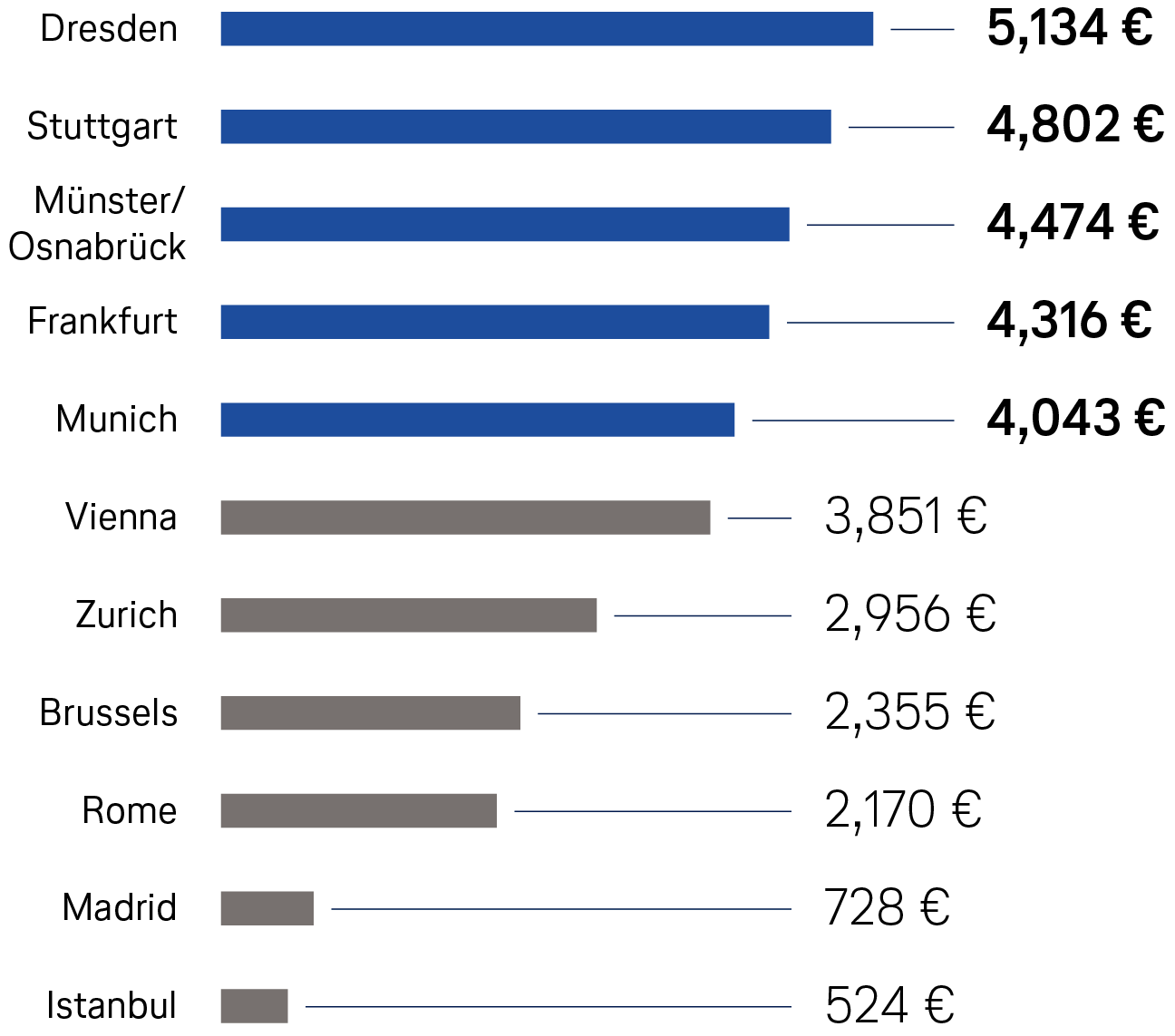
Government-imposed location costs for an A320 flight: EU comparison*
Germany remains one of the most expensive aviation locations in Europe.

*Total comprising aviation tax, air traffic control charges and aviation security fees (including security charge) for an A320 flight carrying 150 passengers to an EU destination; as of 01/07/2026, including aviation tax reduction in Germany; source: BDF


Published by:
Andreas Bartels
Head of Corporate Communications
Lufthansa Group

Dr. Kay Lindemann
Head of Corporate International
Relations and Government Affairs
Lufthansa Group

Deutsche Lufthansa AG
BER CP, Konzernrepräsentanz
Lennéstraße 3, D-10785 Berlin

Editor in chief
Sandra Courant
Head of Political Communication and Media Relations Berlin
Lufthansa Group

Press date
3 June 2026

Agency partner
Köster Kommunikation


Received the policy letter via forwarding? Subscribe  here  for free.